BEST TRENDING DEGREE COURSES
Choosing the right degree course after Class 12 is one of the most important decisions in a student’s life. With so many options available in Science, Commerce, Arts, Technology, Business, Healthcare and Creative Industries, students often feel confused about which course to choose, which university is best, how much fees they will need to pay, and what career opportunities they can expect after graduation.
If you are also confused about your future, don’t worry! This complete guide will help you understand the best trending degree courses in India, their eligibility criteria, admission process, top universities, fee categories, career opportunities and future scope.
Remember: A degree gives you academic knowledge, but practical skills, internships, communication and real-world experience help you prepare for your career.
1. What Are Trending Degree Courses?
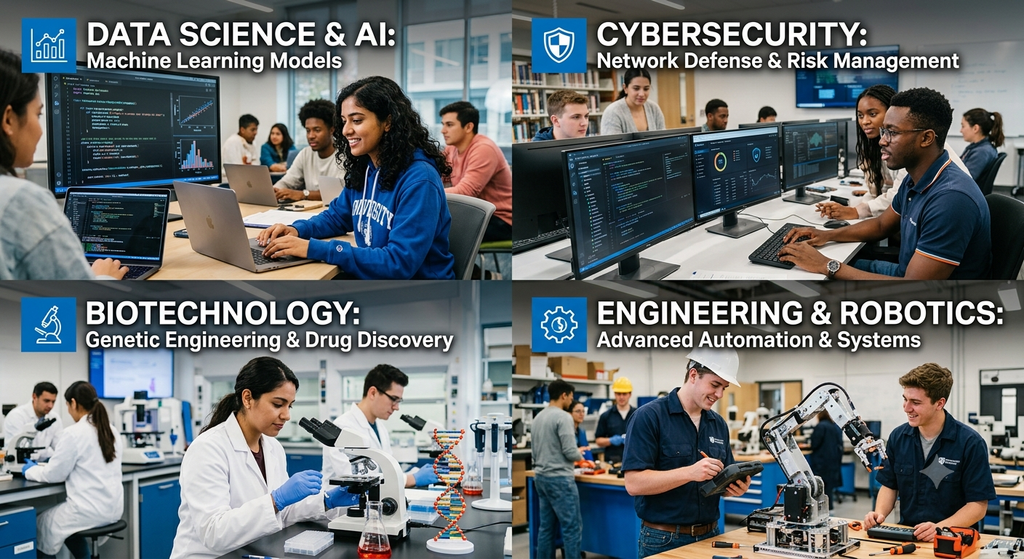
Trending degree courses are programmes that attract students because of their relevance to changing industries, technology, business requirements and career opportunities. Their popularity and job prospects may change over time, so students should consider their interests and the quality of the course rather than following trends blindly.
Some popular degree options include:
- Computer Science and Artificial Intelligence
- Data Science and Information Technology
- Bachelor of Business Administration (BBA)
- Bachelor of Commerce (B.Com)
- Bachelor of Economics
- Bachelor of Computer Applications (BCA)
- Bachelor of Design (B.Des)
- Journalism and Mass Communication
- Psychology
- Biotechnology and Life Sciences
- Nursing and Allied Healthcare
- Law
- Hotel Management and Hospitality
- Agriculture and Environmental Science
- Digital Media and Communication
Let’s understand each course in detail.
2. Best Trending Degree Courses After Class 12
1. B.Tech in Computer Science, Artificial Intelligence and Data Science
Duration: Usually 4 years
Best for: Students interested in computers, technology, mathematics, programming and problem-solving.
Eligibility criteria:
- Students generally need to complete Class 12 with Physics and Mathematics, along with other required subjects.
- Many engineering colleges require Chemistry or another specified subject combination.
- Minimum marks and entrance examination requirements depend on the institution.
Course structure:
Students study programming, data structures, algorithms, databases, computer networks, software development, machine learning and artificial intelligence. Specialised programmes may also cover cloud computing, cybersecurity and data analytics.
Top university options:
- Indian Institutes of Technology (IITs)
- National Institutes of Technology (NITs)
- Delhi Technological University (DTU)
- Vellore Institute of Technology (VIT)
- Anna University
Admission process:
For IITs, students generally qualify through JEE Main followed by JEE Advanced. NIT admissions are generally conducted through JEE Main and JoSAA counselling. Other institutions may use their own entrance examinations or selection processes.
Fees category: Government engineering institutions may offer comparatively affordable tuition, while private engineering universities can cost considerably more. Hostel and other charges are additional.
Career opportunities:
- Software Developer
- AI or Machine Learning Engineer
- Data Analyst
- Cloud Engineer
- Software Tester
- Cybersecurity Professional
Future scope: Artificial intelligence, automation, software products and data-driven businesses are important technology areas. However, employment depends on technical ability, projects, internships and continuous learning.
2. Bachelor of Computer Applications (BCA)
Duration: Usually 3 years; some universities offer four-year undergraduate structures.
Best for: Students who want to enter the IT field and study computer applications, software and programming.
Eligibility criteria:
- Class 12 from a recognised board.
- Mathematics or Computer Science may be required by certain universities, while others accept different subject combinations.
- Check the specific university’s admission rules.
Course structure:
Programming languages, web development, databases, operating systems, networking, software engineering and computer applications form the core curriculum.
Top university options:
- Guru Gobind Singh Indraprastha University (GGSIPU)
- Christ University
- Symbiosis International (Deemed University)
- Amity University
- Selected colleges affiliated with Delhi University, where applicable programmes are offered.
Admission process: Depending on the institution, admission may be based on Class 12 marks, CUET scores or a university-specific entrance examination.
Fees category: Government and affiliated colleges may be more affordable than private universities.
Career opportunities: Junior Software Developer, Web Developer, IT Support Associate, Application Tester and Database Assistant.
Future scope: Students can build their skills through coding projects, internships and certifications. They may also pursue MCA or other postgraduate programmes if eligible.
3. Bachelor of Business Administration (BBA)
Duration: Usually 3 years; some universities offer four-year programmes.
Best for: Students interested in business, entrepreneurship, management, marketing and leadership.
Eligibility criteria: Class 12 in any stream is accepted by many institutions. Some universities specify minimum marks, subject requirements or entrance tests.
Course structure:
- Principles of Management
- Marketing Management
- Financial Accounting
- Human Resource Management
- Business Communication
- Entrepreneurship
- Business Analytics
- Operations Management
Top university options:
- Shaheed Sukhdev College of Business Studies, University of Delhi
- Christ University
- Symbiosis International (Deemed University)
- Jamia Millia Islamia, for relevant management programmes
- Other recognised central, state and private universities offering BBA.
Admission process: Depending on the university, admission may involve CUET, a university entrance examination, an aptitude test, interviews or merit-based selection.
Fees category: Government colleges are often more affordable, while private universities may charge higher tuition.
Career opportunities: Management Trainee, Marketing Executive, Sales Executive, HR Assistant, Business Development Associate and Entrepreneur.
Future scope: BBA can provide a foundation for an MBA or specialised training in marketing, finance, human resources, operations and analytics. Practical projects and internships are particularly valuable.
4. Bachelor of Commerce (B.Com)
Duration: Usually 3 years; four-year options are also available.
Best for: Commerce students interested in accounting, banking, finance, taxation and business.
Eligibility criteria: Class 12 is required. Many institutions accept students from Commerce, while eligibility for other streams depends on the college. Mathematics may be required for certain specialised programmes.
Course structure:
Financial accounting, corporate accounting, business law, taxation, economics, auditing, business statistics and financial management.
Top university options:
- Shri Ram College of Commerce (SRCC), University of Delhi
- Hindu College, University of Delhi
- Hansraj College, University of Delhi
- Banaras Hindu University (BHU)
- Christ University
Admission process: Many central universities use CUET-UG, while other institutions may follow merit-based or institution-specific procedures.
Fees category: Government colleges generally provide lower-cost options than many private institutions.
Career opportunities: Accounts Executive, Tax Assistant, Banking Associate, Audit Assistant and Finance Operations Executive.
Future scope: B.Com students can consider CA, CMA, CS, MBA, M.Com or finance-related certifications, subject to the relevant eligibility and examination rules.
5. Bachelor of Economics
Duration: Usually 3 years, with four-year options at some universities.
Best for: Students interested in economics, statistics, public policy, finance and research.
Eligibility criteria: Class 12 is required. Mathematics is an important or compulsory subject for many Economics Honours programmes, so students must check the individual course requirements.
Course structure:
Microeconomics, macroeconomics, statistics, econometrics, public finance, development economics and mathematical economics.
Top university options:
- Shri Ram College of Commerce, University of Delhi
- St. Stephen’s College, University of Delhi
- Hindu College, University of Delhi
- Lady Shri Ram College for Women, University of Delhi
- Delhi School of Economics for relevant postgraduate study after graduation.
Admission process: Admission to participating undergraduate programmes may use CUET-UG, subject to university-specific requirements.
Career opportunities: Research Assistant, Economic Analyst Trainee, Banking Professional, Market Research Associate and Policy Research Assistant.
Future scope: Students may pursue postgraduate study in economics, public policy, finance or data analytics. Strong quantitative and analytical skills are valuable.
6. Bachelor of Science (B.Sc.) in Data Science, Statistics or Mathematics
Duration: Usually 3–4 years, depending on the university and programme.
Best for: Students who enjoy numbers, logical reasoning, research and analytical problem-solving.
Eligibility criteria: Class 12 with Mathematics is commonly required for Statistics and Mathematics programmes. Data Science programmes may specify Mathematics, Computer Science or other subjects.
Course structure: Probability, statistics, programming, data visualisation, mathematical modelling, databases and analytical methods.
Top university options:
- Indian Statistical Institute (ISI), for its specific degree programmes and entrance requirements
- University of Delhi colleges offering relevant science programmes
- Indian Institute of Science (IISc), for its applicable undergraduate science programmes
- Other recognised universities offering Data Science, Statistics or Mathematics degrees.
Admission process: Depending on the programme, admission may involve CUET-UG, institute-specific entrance examinations or other selection methods.
Career opportunities: Data Analyst, Statistical Assistant, Research Assistant and Business Intelligence Analyst.
Future scope: Students can develop expertise in analytics, research, statistics and machine learning through further study and practical projects.
7. Bachelor of Design (B.Des.)
Duration: Usually 4 years.
Best for: Students interested in creativity, visual communication, fashion, products, user experience and design thinking.
Eligibility criteria: Class 12 in any stream is accepted by many design programmes, but entrance examinations, portfolios or aptitude tests may be required.
Course structure: Design fundamentals, drawing, visualisation, materials, prototyping, user research, digital tools and specialised design subjects.
Top university options:
- National Institute of Design (NID)
- National Institute of Fashion Technology (NIFT)
- IIT Bombay’s relevant design programmes
- Other recognised design institutes offering specialised undergraduate degrees.
Admission process: Depending on the institution, candidates may need to qualify through design aptitude tests, studio tests, interviews or portfolio-based assessment.
Career opportunities: UI/UX Designer, Product Designer, Fashion Designer, Graphic Designer and Visual Communication Designer.
Future scope: Digital products, user experience, branding and product development create opportunities for skilled designers. A strong portfolio is often essential.
8. Journalism and Mass Communication
Duration: Usually 3–4 years.
Best for: Students interested in writing, news, storytelling, media, photography, public relations and digital content.
Eligibility criteria: Class 12 in any stream is accepted by many programmes. Some institutions conduct entrance tests or interviews.
Course structure: Journalism, reporting, media ethics, public relations, advertising, video production, digital media and communication research.
Top university options:
- Indian Institute of Mass Communication (IIMC), for its applicable programmes
- Jamia Millia Islamia
- University of Delhi colleges offering relevant media courses
- Symbiosis International (Deemed University)
- Other recognised universities offering undergraduate journalism degrees.
Admission process: Requirements vary by course. Some institutions use entrance tests, while others use merit or institution-specific selection.
Career opportunities: Reporter, Content Writer, Video Producer, Social Media Executive, Public Relations Assistant and Digital Journalist.
Future scope: Digital publishing, multimedia storytelling, video production and communication strategy provide opportunities for students with strong practical skills.
9. Bachelor of Arts (BA) in Psychology
Duration: Usually 3–4 years.
Best for: Students interested in human behaviour, emotions, research, learning and social development.
Eligibility criteria: Class 12 is accepted by many universities. Psychology may or may not be required as a school subject, depending on the programme.
Course structure: Introduction to psychology, cognitive psychology, developmental psychology, social psychology, research methods and psychological statistics.
Top university options:
- Lady Shri Ram College for Women, University of Delhi
- Jesus and Mary College, University of Delhi
- Christ University
- Jamia Millia Islamia, for relevant programmes
- Other recognised universities offering undergraduate psychology.
Admission process: Depending on the university, admission may be based on CUET-UG, merit or an institution-specific process.
Career opportunities: Research Assistant, HR Associate, Behavioural Research Assistant and roles in education or community programmes.
Future scope: Students seeking professional careers in psychology usually need further recognised education and supervised training, depending on their chosen specialisation and applicable regulations. An undergraduate degree alone does not qualify someone for every professional psychology role.
10. Biotechnology and Life Sciences
Duration: Usually 3–4 years, depending on the degree.
Best for: Students interested in biology, genetics, laboratory research, healthcare innovation and environmental science.
Eligibility criteria: Class 12 with Biology or other specified science subjects is commonly required. Mathematics or additional science subjects may be required for particular programmes.
Course structure: Genetics, microbiology, molecular biology, biochemistry, cell biology, laboratory methods and biotechnology applications.
Top university options:
- Jawaharlal Nehru University (JNU), for applicable life-science programmes
- University of Hyderabad, for its relevant integrated science programmes
- Banaras Hindu University
- Other recognised universities offering undergraduate biotechnology or life sciences.
Admission process: Depending on the programme, admission may be through CUET-UG, an institution-specific test or other approved selection procedures.
Career opportunities: Laboratory Assistant, Research Assistant, Quality Control Trainee and Biotechnology Industry Associate.
Future scope: Research, pharmaceuticals, diagnostics, agriculture and environmental biotechnology are possible pathways. Specialised research positions commonly require postgraduate study or further training.
11. Nursing and Allied Healthcare Degrees
Duration: B.Sc. Nursing is generally 4 years; allied healthcare degree durations vary by programme.
Best for: Students interested in patient care, diagnostics, rehabilitation and healthcare services.
Eligibility criteria: Requirements differ between Nursing and allied healthcare programmes. B.Sc. Nursing generally requires Class 12 with specified science subjects, including Physics, Chemistry and Biology, along with English and other prescribed conditions.
Course structure: Anatomy, physiology, patient care, clinical practice, healthcare ethics and specialised clinical or diagnostic subjects.
Top university and institution options:
- All India Institute of Medical Sciences (AIIMS), for applicable nursing and healthcare programmes
- Jamia Hamdard
- Banaras Hindu University, for applicable programmes
- Recognised government medical colleges and healthcare institutions.
Admission process: Institutions may use entrance examinations, merit-based selection or designated counselling procedures. Students should verify recognition, clinical training and applicable registration requirements before enrolling.
Career opportunities: Registered Nurse, Diagnostic Technologist, Rehabilitation Professional and other programme-specific healthcare roles.
Future scope: Healthcare services remain an important sector, but eligibility for clinical work depends on the exact degree, professional registration and applicable regulations.
12. Bachelor of Laws (LL.B.) Through an Integrated Degree
Duration: Usually 5 years after Class 12 for an integrated programme such as BA LL.B. or BBA LL.B.
Best for: Students interested in law, legal research, public policy, justice and advocacy.
Eligibility criteria: Class 12 with the minimum marks specified by the institution. Entrance examinations may be required.
Course structure: Constitutional law, criminal law, contract law, legal research, civil procedure, internships and moot court activities.
Top university options:
- National Law School of India University (NLSIU), Bengaluru
- National Law University, Delhi
- NALSAR University of Law, Hyderabad
- Faculty of Law, Jamia Millia Islamia
- Other recognised law universities.
Admission process: CLAT is used by participating National Law Universities, with exceptions according to individual admission rules. NLU Delhi conducts its own AILET examination. Other institutions may use separate processes.
Career opportunities: Legal Research Assistant, Law Firm Associate Trainee, Corporate Legal Assistant and further pathways towards legal practice after meeting applicable requirements.
Future scope: Corporate law, litigation, legal research, compliance and public policy are potential pathways. To practise as an advocate in India, graduates must satisfy applicable professional enrolment and qualification requirements.
13. Hotel Management and Hospitality
Duration: Commonly 3–4 years, depending on the programme.
Best for: Students interested in hospitality, tourism, event management, customer service and food service operations.
Eligibility criteria: Class 12 from a recognised board is accepted by many programmes. Some institutions require an entrance examination or additional selection steps.
Course structure: Food production, accommodation operations, hospitality management, customer relations, event planning and tourism services.
Top institution options:
- Institute of Hotel Management (IHM), Pusa
- Other Institutes of Hotel Management under the relevant national system
- Recognised private universities offering hospitality degrees.
Admission process: Some programmes use NCHM JEE, while other institutions may have separate admission processes.
Career opportunities: Hotel Operations Trainee, Guest Relations Associate, Event Coordinator, Food Service Supervisor and Tourism Operations Associate.
Future scope: Hotels, tourism, events, restaurants and hospitality businesses offer different pathways. Practical training and communication skills are particularly important.
14. Agriculture and Environmental Science
Duration: B.Sc. Agriculture is generally 4 years; Environmental Science degree duration varies.
Best for: Students interested in agriculture, food production, sustainability, environmental protection and rural development.
Eligibility criteria: Agriculture programmes usually specify Class 12 science or other permitted subject combinations. Requirements vary by university. Environmental Science programmes may accept a wider range of science backgrounds.
Course structure: Crop science, soil science, plant protection, agricultural economics, ecology, environmental management and research methods.
Top university options:
- Indian Agricultural Research Institute (IARI), for its applicable programmes
- Punjab Agricultural University
- Tamil Nadu Agricultural University
- Banaras Hindu University, for relevant programmes
- Other recognised agricultural universities.
Admission process: Depending on the institution and course, admissions may use ICAR-related processes, CUET-UG or state and university admission systems. Check the current prospectus.
Career opportunities: Agricultural Extension Assistant, Research Assistant, Quality Control Trainee, Environmental Project Assistant and Agri-business Associate.
Future scope: Sustainable farming, food supply, agricultural technology and environmental management provide potential career pathways.
3. Eligibility Criteria: Which Course Can You Choose After Class 12?
Your stream can help narrow down your options, but it does not decide your entire future.
| Class 12 stream | Degree options to explore |
|---|---|
| Science with PCM | B.Tech, B.Sc. Mathematics, Statistics, Computer Science, eligible BCA and Design programmes |
| Science with PCB | Nursing, Biotechnology, Life Sciences, Agriculture and eligible allied healthcare programmes |
| Commerce | B.Com, BBA, Economics where eligible, Law, Journalism and Management |
| Arts/Humanities | BA, Psychology where eligible, Journalism, Law, Design and Hospitality |
| Any stream, depending on university rules | BBA, Law, Design, Media and selected Computer Applications or other programmes |
4. Admission Process: How to Get Into a Good University
Follow these steps to apply confidently.
Step 1: Choose your course. Identify your interests, strengths, preferred subjects and career goals.
Step 2: Check eligibility. Read the official course page for Class 12 subject requirements, minimum marks and age or other conditions, if any.
Step 3: Identify the entrance examination. Depending on your course, you may need CUET-UG, JEE Main, JEE Advanced, CLAT, AILET, NID DAT, NCHM JEE or an institution-specific examination.
Step 4: Register on the official website. Complete the application carefully, select the correct subjects or papers, upload required documents and pay the prescribed fee.
Step 5: Prepare for selection. Follow the relevant examination syllabus, practise previous papers where available and prepare for interviews or portfolios if required.
Step 6: Complete counselling and admission. Check merit lists, counselling schedules, seat allocation, document verification and fee payment deadlines.
Step 7: Verify the final offer. Confirm the campus, degree title, total fee, refund rules and recognition before accepting admission.
The National Testing Agency explains that CUET-UG scores are used by participating central and other universities, but participation and programme-specific eligibility must be checked separately. Official information is available at https://cuet.nta.nic.in/.
5. Top Universities in India: How to Choose the Right One
A famous university is not automatically the best choice for every student. Compare the course, faculty, practical training, cost and student support before deciding.
| University or institution | Courses or fields to explore |
|---|---|
| IITs | Engineering, technology and selected science or design programmes |
| NITs | Engineering and technology |
| University of Delhi | Commerce, Economics, Humanities and selected science and management programmes |
| Banaras Hindu University | Science, Commerce, Humanities and other professional programmes |
| Jawaharlal Nehru University | Selected science, language and interdisciplinary programmes |
| Jamia Millia Islamia | Engineering, Media, Humanities and selected professional programmes |
| Christ University | Management, Commerce, Psychology and other undergraduate programmes |
| Symbiosis International | Management, Media, Design and other specialised fields |
| NID and NIFT | Design and fashion-related programmes |
| AIIMS | Applicable medical, nursing and healthcare programmes |
| National Law Universities | Law and legal education |
| State agricultural universities | Agriculture and related sciences |
Always verify that the exact degree and campus you choose are recognised and meet the requirements for your intended career.
6. Degree Course Fees in India: Government vs Private Universities
Fees vary considerably by course, campus, category, facilities and academic year. The following are broad planning estimates, not official fee quotations.
| Fee category | Indicative tuition cost |
|---|---|
| Affordable government or aided college | Around ₹5,000–₹50,000 per year |
| Other government or public university programmes | Around ₹20,000–₹1,00,000 per year |
| Many private university programmes | Around ₹80,000–₹3,00,000 per year |
| Specialised private or professional programmes | May exceed ₹3,00,000 per year |
These ranges are illustrative. Medical, professional, residential and specialised programmes can cost much more, while some public programmes cost less. Engineering, design and healthcare courses may also have additional laboratory, studio or clinical charges.
Before selecting a college, calculate the total cost of the degree, including:
- Tuition and admission fees
- Examination and laboratory charges
- Hostel and food expenses
- Books, laptop and learning materials
- Transport and personal expenses
- Internship or project-related costs, where applicable
Students should also check scholarships, fee waivers, government assistance and education-loan options where appropriate. Do not choose a university based only on its advertised first-year tuition.
7. Career Opportunities and Future Scope After Graduation
A degree can lead to employment, higher education, professional qualifications or entrepreneurship. Your next step depends on your chosen field.
| Degree | Possible career direction | Useful additional skills |
|---|---|---|
| B.Tech CSE/AI | Software, data and technology | Programming, projects and problem-solving |
| BCA | IT and application development | Coding, databases and web development |
| BBA | Business and management | Communication, Excel and presentations |
| B.Com | Accounting and finance | Excel, accounting software and financial literacy |
| Economics | Research, analytics and finance | Statistics, spreadsheets and analytical writing |
| B.Sc. Data Science | Data and research | Python, statistics and visualisation |
| B.Des. | Product, graphic and digital design | Design tools and portfolio building |
| Journalism | Media and content | Writing, editing and video production |
| Psychology | Research, education and people-related roles | Research methods and communication |
| Biotechnology | Laboratory and research support | Lab techniques and scientific writing |
| Nursing | Nursing and healthcare | Clinical practice and professional registration |
| Law | Legal research and legal practice pathways | Legal writing, research and internships |
| Hospitality | Hotels, tourism and events | Customer service and operational skills |
| Agriculture | Agri-business and research support | Fieldwork, data collection and communication |
No degree guarantees a job or a specific salary. Employment depends on skills, experience, location, industry demand and the requirements of each role.
8. Why Practical Skills Are as Important as Your Degree
Many students focus only on getting admission to a reputed university. However, your degree becomes more useful when you combine it with skills that employers and clients need.
Consider learning:
Digital marketing: SEO, content marketing, social media strategy, analytics and email marketing.
Communication: Professional English, presentations, writing, teamwork and interview preparation.
Digital tools: Spreadsheets, presentation software, research tools and relevant AI applications.
Technical skills: Coding for technology careers, accounting tools for finance, research methods for social sciences, or design software for creative fields.
Real-world experience: Internships, academic projects, volunteering, competitions and portfolio development.
For example, a B.Com student can learn Excel and accounting software. A BBA student can develop marketing campaigns. A BCA student can build a website. A Journalism student can create a portfolio of original articles and videos.
You do not need to learn every skill at once. Choose skills that support your degree and practise them consistently.
9. How to Choose the Best Degree Course for Yourself
Before making your final decision, ask yourself these questions:
- Which subjects do I genuinely enjoy studying?
- What kind of work would I like to do in the future?
- Does the course require Mathematics, Biology or another specific subject?
- Which entrance examination should I prepare for?
- Can I afford the tuition and living expenses?
- Does the university provide practical training, internships and career support?
- Will I need a postgraduate degree or professional qualification?
- What alternative colleges and courses can I consider?
Prepare a shortlist of at least three institutions: an ambitious option, a realistic option and a more affordable backup. Compare the official eligibility criteria, admission route, curriculum, total fees and location before applying.
10. Frequently Asked Questions (FAQs)
Q1. Which degree course is best after Class 12?
There is no single best degree for everyone. B.Tech may suit students interested in engineering, B.Com may suit students interested in accounting and finance, and BBA may suit students interested in business. The best option is one that matches your interests, eligibility, budget and career goals.
Q2. Can Arts students pursue trending career courses?
Yes. Depending on university rules, Arts students can explore Journalism, Law, Design, Psychology, Hospitality, Business and many Humanities programmes. Some technical and science degrees require specific Class 12 subjects.
Q3. Which degree has the lowest fees?
Fees depend on the college and programme. Some government and aided colleges offer relatively affordable degrees in Arts, Commerce and Science. Always compare the complete cost rather than tuition alone.
Q4. Is a degree enough to get a job?
A degree is an important qualification for many roles, but practical skills, internships, projects, communication and experience can improve your readiness for employment.
Q5. Can I learn digital marketing while pursuing a degree?
Yes. Many students learn digital marketing, content writing, web development or other relevant skills alongside their academic studies. Start with one skill and practise through projects.
Q6. Which entrance exam should I prepare for?
It depends on the course and university. Examples include CUET-UG for participating universities, JEE Main for many engineering admissions, CLAT for participating National Law Universities, and other institution-specific examinations. Always check the latest official admission notice.
Q7. How can I find the exact fees and eligibility criteria?
Visit the university’s official website, open the relevant course page or admission prospectus, and check the current academic year’s fee schedule, required subjects, selection process and deadlines.
Conclusion: Choose Your Degree With Confidence
Choosing a degree is not just about selecting a popular course. It is about understanding yourself, exploring career options and making an informed decision that fits your circumstances.
India offers many opportunities in technology, business, commerce, design, healthcare, law, media, science and other fields. Start by shortlisting courses you genuinely like, checking your eligibility, comparing recognised universities and calculating your total education budget.
Most importantly, do not depend on a degree alone. Build practical skills, complete projects, gain experience and keep learning as industries change.
Your future does not depend on choosing the trendiest degree. It depends on choosing a suitable path and making the most of the opportunities available to you.