
Finished Class 10 and confused about what to do next? Science, Commerce, Arts or something completely different? You are not alone
For many students, Class 10 is the first time they feel that they have to make a “big career decision.” Friends may be choosing Science, parents may suggest Commerce, teachers may recommend Humanities, and the internet may give you ten different opinions in ten minutes.
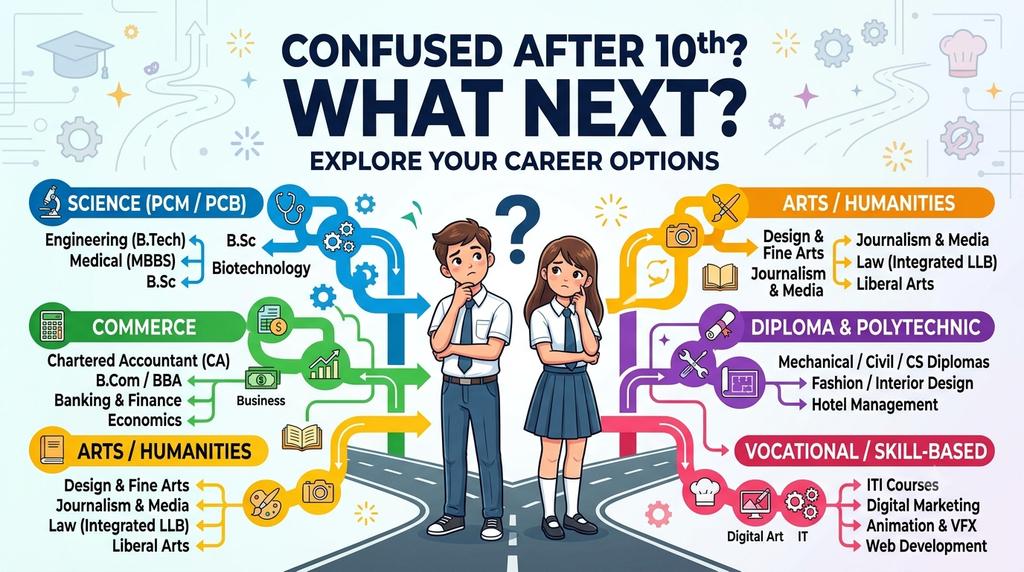
The good news is that you do not need to have your entire life figured out after Class 10.
What you do need is the right information to make a thoughtful decision about your next step.
In this guide, we will understand the major streams after Class 10, how to choose one, what mistakes to avoid, and how to connect your stream with your future career.
- First Things First: Don’t Panic!
Feeling confused after Class 10 is completely normal.
You may be thinking:
- “Which stream should I choose?”
- “Is Science really better than other streams?”
- “What if I choose the wrong subject?”
- “Which stream has the most career options?”
- “What if I don’t know what career I want?”
- “Should I follow my friends?”
Take a breath.
Choosing a stream is an important decision, but it does not mean you have to decide your entire life at this moment.
Your goal should be to understand your interests, strengths, possible career directions and course requirements before making a decision.
- What Are the Main Streams After Class 10?
In many schools, students generally choose between three broad streams:
🔬 Science
Science is often considered by students interested in subjects such as Mathematics, Physics, Chemistry and Biology.
Depending on the school and subject combination, Science can lead towards areas such as:
- Engineering
- Medicine
- Computer Science
- Biotechnology
- Research
- Technology
- Architecture
- Data-related fields
Students may encounter combinations such as PCM (Physics, Chemistry, Mathematics) or PCB (Physics, Chemistry, Biology). Some schools may offer additional combinations.
However, subject combinations differ between schools, so always check what your school actually offers.
Important:
Don’t choose Science simply because people say it has “more scope.”
Science can be a great option for a student who genuinely enjoys its subjects and wants to explore careers that require them.
- Commerce: More Than Just Accounts
Commerce is another popular choice after Class 10.
It is generally suitable for students interested in areas such as:
- Business
- Finance
- Accounting
- Economics
- Banking
- Entrepreneurship
- Management
Common Commerce subjects can include:
- Accountancy
- Business Studies
- Economics
- Mathematics or Applied Mathematics, depending on the school
- English
Commerce can lead to different educational and career pathways, including areas such as:
B.Com → Finance → Banking → Accounting → Business
or
BBA → Management → Marketing → Entrepreneurship
Students may also explore professional qualifications such as CA and other finance-related pathways, depending on their interests and eligibility.
So, if someone tells you that Commerce is “only for CA,” remember that Commerce has many other possibilities too.
- Humanities / Arts: A Stream With Many Directions
Humanities is sometimes misunderstood.
Some students believe that Arts has fewer career opportunities, but that’s an oversimplification.
Humanities can include subjects such as:
- History
- Political Science
- Geography
- Psychology
- Sociology
- Economics
- Languages
- Other humanities and social science subjects
Students interested in areas such as law, media, teaching, social sciences, public policy, psychology, writing, communication and civil services may explore Humanities-related pathways.
For example:
Humanities → BA → Law
or
Humanities → BA Psychology → Psychology-related higher studies
or
Humanities → Political Science/History/Economics → Higher Studies / Teaching / Public Policy / Other careers
The exact pathway depends on the course, institution and eligibility requirements.
- Don’t Choose a Stream Because Your Friend Is Choosing It
This is one of the most common mistakes students make.
Your best friend may be choosing Science.
Another friend may be choosing Commerce.
Someone else may be choosing Humanities.
That doesn’t mean you need to make the same choice.
Your friend’s strengths, interests and career goals may be completely different from yours.
Instead of asking:
“Mere friends kya le rahe hain?”
ask yourself:
“Mujhe kya padhna genuinely interesting lagta hai?”
Your Class 11 subjects will become a major part of your daily academic life, so choose them based on your own interests and goals.
- Don’t Choose Only Because of Your Marks
Marks are important, but they are not the complete picture.
For example, scoring well in Class 10 does not automatically mean that Science is the right choice.
Similarly, scoring less in one subject does not mean that you can never build a successful career related to that area.
Think about:
- Your interests
- Your strengths
- Your willingness to study the subjects
- Your learning style
- Your future career interests
- The requirements of the courses you may want to pursue
Use your marks as one piece of information, not as the only deciding factor.
- Start With Your Career, Then Work Backwards
If you already have a career in mind, choosing your stream becomes easier.
Use this simple process:
Career → Course → Eligibility → Subjects → Stream
For example, suppose you want to explore a career that requires specific Science subjects.
First, research the career.
Then find the relevant undergraduate course.
Then check the course’s eligibility requirements.
Then check which Class 11–12 subjects are expected or useful.
Finally, choose the appropriate stream and subject combination.
This approach can prevent you from discovering too late that a particular course requires subjects you did not take.
- What If You Don’t Know Your Career Yet?
That’s completely okay.
You don’t have to decide your exact job title immediately after Class 10.
Instead, start with career exploration.
Ask yourself:
Question 1: Which subjects do I enjoy?
Do you enjoy:
- Maths?
- Science?
- Economics?
- History?
- Political Science?
- Psychology?
- English?
- Computers?
- Art and design?
Question 2: What type of work sounds interesting?
Would you prefer:
- Working with people?
- Working with numbers?
- Creating things?
- Teaching?
- Writing?
- Running a business?
- Working with technology?
- Researching?
- Helping people?
- Working in a creative field?
Question 3: What careers connect with these interests?
Once you have some possibilities, research them.
You don’t need to choose one career immediately. You can create a shortlist and explore each option.
- Your Stream Does Not Define Your Entire Personality
A stream is an academic pathway, not your identity.
Choosing Commerce does not mean you can only work in accounting.
Choosing Humanities does not mean you can only become a teacher.
Choosing Science does not mean you must become an engineer or doctor.
There are multiple courses and career pathways available, although some careers have specific subject and eligibility requirements.
That’s why it is important to research before making your Class 11 subject choices.
- What About CUET After Class 12?
If you are planning undergraduate admission in India, you may hear about CUET-UG.
CUET-UG is used by participating universities for undergraduate admissions.
However, students should not assume that every course has the same requirements.
Different universities and courses may have different:
- Eligibility requirements
- Subject requirements
- Admission rules
- Entrance requirements
Therefore, if you already have a particular university or course in mind, check its official admission information.
A useful approach is:
Course → University → Eligibility → Subject requirements → Admission process
This is much safer than relying only on social media videos or advice from friends.
- Common Mistakes Students Make After Class 10
Mistake 1: “Science has the most scope.”
Every stream has different educational and career possibilities.
The better question is:
“Which stream is suitable for my interests and the careers I want to explore?”
Mistake 2: Choosing because of pressure
Parents and relatives usually want the best for you, but you should also understand the subjects and career pathway yourself.
Mistake 3: Following friends
Your friend’s career goal is not automatically your career goal.
Mistake 4: Ignoring subject combinations
Don’t just ask, “Science or Commerce?”
Find out exactly which subjects you will study.
Mistake 5: Not checking eligibility
If you have a particular career or course in mind, check the official requirements before selecting your subjects.
Mistake 6: Believing internet myths
Statements like:
“Arts has no scope.”
“Commerce is only for CA.”
“Science is always the best.” are oversimplifications.
Do your own research before believing them.
- A Simple Formula to Choose Your Stream
Still confused?
Try this five-step method:
❤️ Step 1: Interest
What subjects do I actually enjoy?
↓
💪 Step 2: Strength
What subjects or skills am I reasonably good at?
↓
🎯 Step 3: Career Exploration
What careers connect with my interests?
↓
📚 Step 4: Course Research
Which courses can lead towards those career areas?
↓
📝 Step 5: Subject Requirements
Which Class 11–12 subjects are required or useful for those courses?
↓
🎓 Final Step: Choose Your Stream
Now compare the available options and choose the stream and subjects that fit your situation.
- Quick Comparison of the Three Streams
Stream| Common Areas of Study| Example Career Areas
Science| Physics, Chemistry, Maths/Biology| Engineering, Medicine, Technology, Research
Commerce| Accounts, Business, Economics| Finance, Banking, Business, Management
Humanities| History, Political Science, Psychology, Sociology, etc.| Law, Media, Teaching, Social Sciences, Policy
Remember: actual subjects, combinations and eligibility can vary by school, university and course.
- What Should You Do Right Now?
If you are currently in Class 10 and confused, don’t spend all your time worrying about the decision.
Instead, create a small career exploration list.
This week:
- Write down your favourite subjects.
- Write down subjects you don’t enjoy.
- List 5 careers that sound interesting.
- Research the courses required for those careers.
- Check the Class 11 subjects required or useful for those courses.
- Talk to your parents or teachers after doing your own research.
- Compare your options before making the final decision.
This will give you a much clearer picture.
Final Thoughts: You Don’t Need to Have Everything Figured Out
Being confused after Class 10 doesn’t mean you are behind.
It simply means you need more information.
Don’t choose a stream because it is considered “best.” Don’t choose it because your friends are choosing it. And don’t assume that one stream automatically guarantees success.
Instead, understand yourself, explore different careers, research courses and check eligibility requirements.
Your decision can start with four simple questions:
What do I enjoy?
What am I good at?
What careers interest me?
What subjects and courses do those careers require?
You don’t have to plan your entire life at 15 or 16.
You just need enough information to make your next good decision.
Start Your Career Journey With CareerSathi
Still confused about what to choose after Class 10?
Explore different streams, subjects, careers, courses, colleges and entrance exams step by step with CareerSathi.
Your career journey doesn’t need to start with a perfect answer. It starts with the right questions.