Career Options After 12th:
What Can You Do After Class 12?
Class 12 is not the end of your education journey—it is the beginning of your career journey.
After Class 12, students have hundreds of career options, but choosing the right one can be confusing. Many students ask:
- Which course should I choose after 12th?
- Which career is suitable for my stream?
- Can I change my field after 12th?
- Which entrance exam should I prepare for?
- Which degree is required for a particular career?
- Should I choose a regular college or another mode of study?
- What can I do after graduation?
- Which skills should I develop along with my degree?
The answer depends on your stream, subjects, interests, strengths, career goals and eligibility requirements.
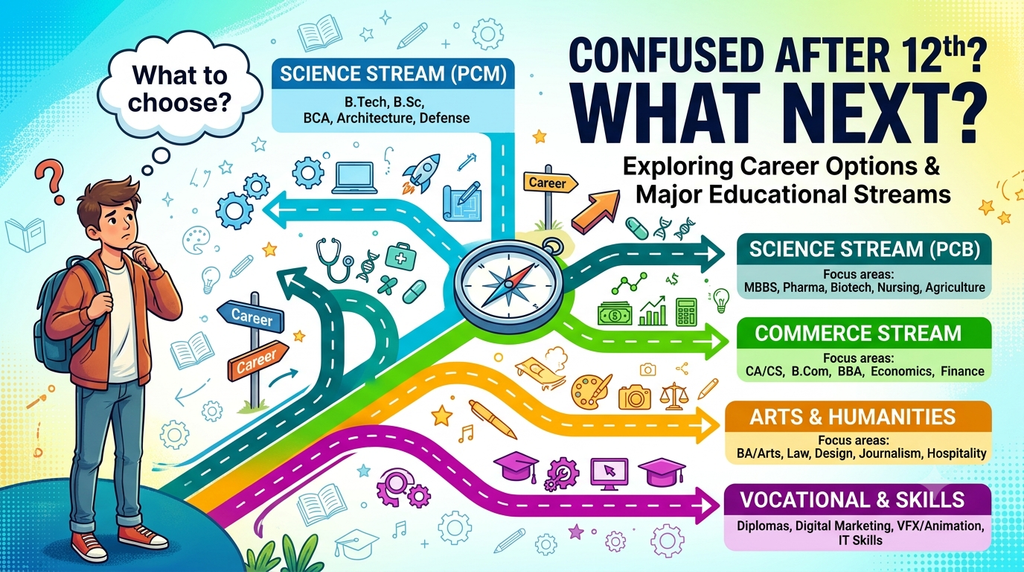
This guide explains the major career options after Class 12 for Science, Commerce, Arts/Humanities and Vocational/Skill-based students.
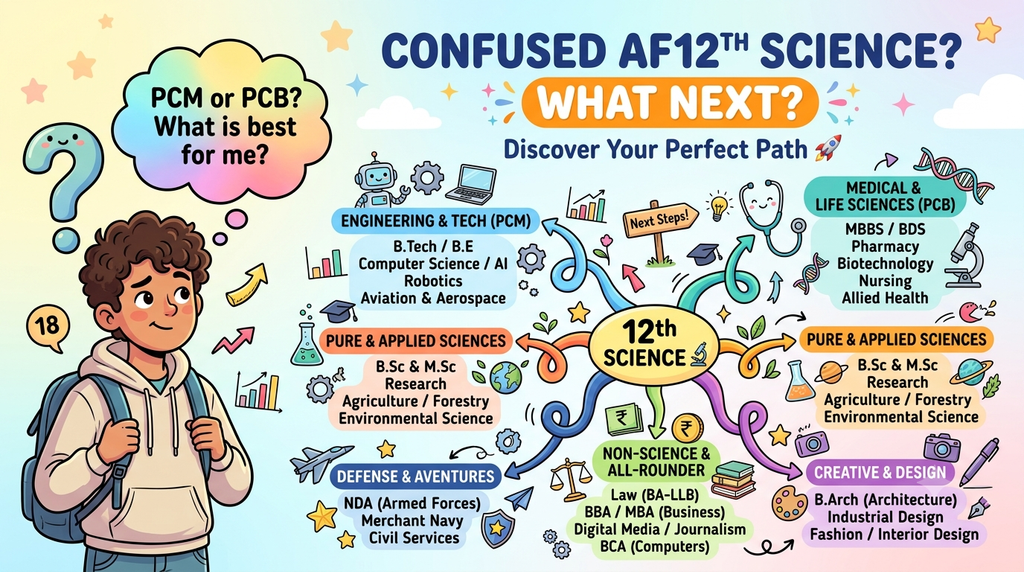
1. Career Options After 12th Science
Science is generally divided into two major combinations:
PCM
Physics + Chemistry + Mathematics
PCB
Physics + Chemistry + Biology
Some students also have PCMB, Computer Science, Biotechnology or other subjects.
Science does not mean that you can only become an engineer or doctor. There are many options in technology, research, management, design, defence, architecture, economics, data, teaching and other fields.
A. Engineering & Technology
Popular Courses
- B.Tech
- B.E.
- BCA
- B.Sc Computer Science
- B.Sc Information Technology
- B.Tech Artificial Intelligence
- B.Tech Data Science
- B.Tech Computer Science
- B.Tech Electronics
- B.Tech Mechanical Engineering
- B.Tech Civil Engineering
- B.Tech Electrical Engineering
- B.Tech Biotechnology
Career Options
After studying engineering or technology, students can work in areas such as:
- Software development
- Web development
- Data analysis
- Artificial Intelligence
- Cybersecurity
- Cloud computing
- Electronics
- Mechanical engineering
- Civil engineering
- Manufacturing
- Research and development
- Technical consulting
Students can later pursue M.Tech, M.Sc, MBA, specialised certifications or research.
B. Medicine & Healthcare
Students with Biology can explore several healthcare-related careers.
Courses
- MBBS
- BDS
- BAMS
- BHMS
- BPT
- B.Sc Nursing
- B.Pharm
- Biotechnology
- Microbiology
- Medical Laboratory Technology
- Radiology-related programmes
- Allied health science programmes
Career Areas
Depending on the course and required registration/licensing, students can work in:
- Hospitals
- Clinics
- Laboratories
- Pharmaceutical companies
- Research organisations
- Public health
- Medical technology
- Healthcare administration
Medicine is a long-term professional pathway, so students should understand the course duration, entrance examination, internship and professional-registration requirements before choosing it.
C. Pure Science & Research
If you enjoy understanding how things work and want to explore scientific research, pure science can be a strong pathway.
Courses
- B.Sc Physics
- B.Sc Chemistry
- B.Sc Mathematics
- B.Sc Biology
- B.Sc Zoology
- B.Sc Botany
- B.Sc Biotechnology
- B.Sc Microbiology
- B.Sc Environmental Science
- B.Sc Statistics
Career Path
A common academic route is:
12th → B.Sc → M.Sc → Research/PhD
Depending on the field and qualifications, students may move into:
- Scientific research
- Laboratory work
- Teaching
- Data-related roles
- Environmental work
- Research organisations
- Higher education
D. Architecture & Design
Students interested in buildings, spaces, creativity and design can explore:
- B.Arch
- B.Des
- Interior Design
- Product Design
- Fashion Design
- Communication Design
- Industrial Design
- Animation
- UX/UI Design
Possible Careers
- Architect
- Interior designer
- Product designer
- Graphic designer
- UX/UI designer
- Animation professional
- Fashion designer
- Design researcher
Architecture has specific eligibility and entrance requirements, so students should check the current rules before applying.
E. Mathematics, Statistics & Data
If you enjoy Mathematics and logical problem-solving, consider:
- B.Sc Mathematics
- B.Sc Statistics
- Data Science
- Computer Science
- Economics with Mathematics
- Actuarial Science
- Statistics-related programmes
Career Areas
- Data analyst
- Statistician
- Business analyst
- Data scientist
- Research analyst
- Actuarial professional
- Quantitative roles
These careers increasingly require practical skills such as Excel, statistics, programming and data visualisation.
F. Defence & Government Careers
Science students can also prepare for various government and defence-related pathways.
Depending on the specific examination and eligibility requirements, opportunities can include:
- Defence services
- Central government jobs
- State government jobs
- Technical government positions
- Scientific organisations
- Public-sector careers
For government careers, students should check the official recruitment notification because age, subjects, physical standards and qualification requirements differ by examination.
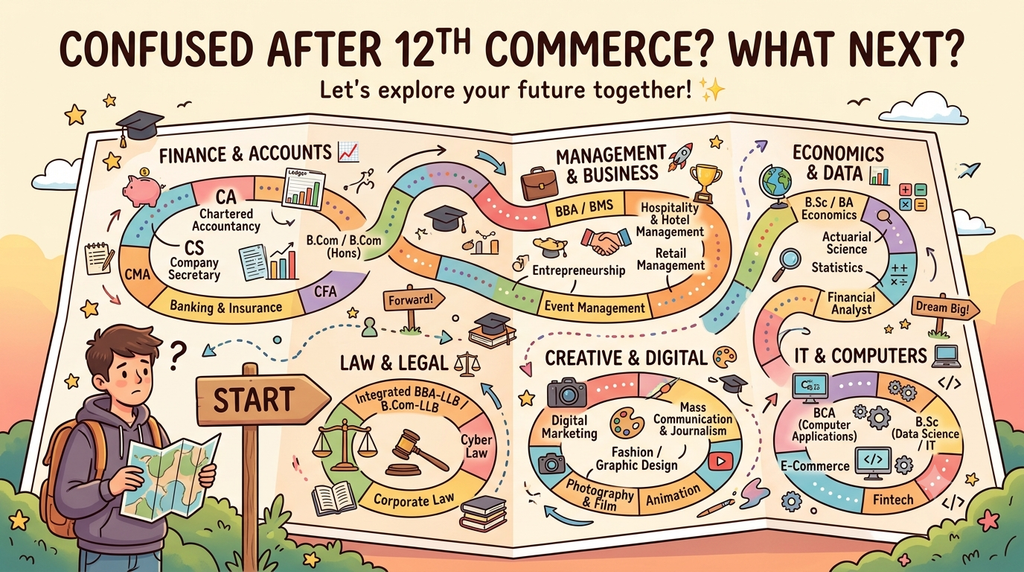
2. Career Options After 12th Commerce
Commerce is a popular stream for students interested in:
- Business
- Accounting
- Finance
- Economics
- Banking
- Management
- Entrepreneurship
But Commerce is much broader than accounting.
A. Chartered Accountancy – CA
CA is a professional qualification focused on areas such as:
- Accounting
- Taxation
- Auditing
- Financial reporting
- Business laws
- Financial management
Possible Career Areas
A qualified CA can work in:
- Accounting
- Audit
- Taxation
- Corporate finance
- Consulting
- Financial reporting
- Professional practice
CA has its own professional examination and training pathway. Students should refer to the Institute of Chartered Accountants of India for the current route and requirements.
B. Company Secretary – CS
Company Secretaries work around areas such as:
- Corporate law
- Compliance
- Corporate governance
- Company regulations
- Legal documentation
Career Areas
- Corporate compliance
- Company law
- Governance
- Secretarial practice
- Legal and regulatory work
Students interested in law and business management may consider this pathway.
C. Cost & Management Accounting – CMA
CMA focuses on:
- Cost accounting
- Management accounting
- Financial management
- Business strategy
- Cost control
Career Areas
- Cost management
- Financial analysis
- Management accounting
- Corporate finance
- Business planning
D. B.Com
B.Com is one of the most common undergraduate options after Commerce.
Students can explore areas such as:
- Accounting
- Finance
- Economics
- Taxation
- Banking
- Business
- Management
After B.Com
A student may continue with:
B.Com → M.Com
or
B.Com → MBA
or
B.Com → Professional qualification
or
B.Com → Government/competitive examinations
or enter employment depending on skills and eligibility.
E. Economics
Students interested in economics can choose:
- B.A. Economics
- B.Sc Economics
- Economics-related interdisciplinary programmes
Career Areas
- Economic research
- Banking
- Financial analysis
- Consulting
- Policy research
- Data analysis
- Market research
- Teaching and academia
Economics becomes particularly useful when combined with mathematics, statistics, data analysis and research skills.
F. Business & Management
Students interested in running businesses or working in companies can consider:
- BBA
- BMS
- BBM
- Integrated management programmes
- Business-related bachelor’s degrees
Career Areas
- Marketing
- Human resources
- Finance
- Sales
- Operations
- Business development
- Consulting
- Entrepreneurship
Some institutions also offer five-year integrated management programmes after Class 12. For example, IIM Indore’s IPM is a five-year programme with Class 12 eligibility subject to its current admission rules.
G. Banking & Finance
Commerce students can build careers in:
- Banking
- Financial services
- Investment-related fields
- Insurance
- Accounting
- Financial analysis
- Corporate finance
Useful degrees include:
- B.Com
- BBA Finance
- Economics
- Finance-related bachelor’s programmes
Additional professional qualifications and competitive examinations may be required for specific roles.
H. Entrepreneurship
If you want to build your own business, you can study:
- BBA
- B.Com
- Economics
- Entrepreneurship
- Marketing
- Business management
However, a degree is not the only requirement for entrepreneurship. Practical knowledge of:
- Marketing
- Finance
- Sales
- Customer service
- Digital tools
- Business communication
can be equally important.
3. Career Options After 12th Arts/Humanities
Arts/Humanities is one of the most flexible streams.
Students can study subjects such as:
- History
- Political Science
- Geography
- Economics
- Sociology
- Psychology
- English
- Languages
- Philosophy
- Fine Arts
Arts students can enter careers in education, law, government, media, design, psychology, management, social sciences, research and many other areas.
A. Law
Students from Arts, Commerce and Science can generally explore undergraduate law programmes subject to the institution’s eligibility requirements.
Popular routes include:
- 5-year integrated law programmes after Class 12
- BA LLB
- BBA LLB
- B.Com LLB
- B.Sc LLB where offered
Career Areas
- Legal practice
- Corporate law
- Legal research
- Compliance
- Legal consulting
- Public policy
- Judiciary-related preparation
Students should check the current entrance and eligibility requirements of the law institution they want to join.
B. Teaching & Education
Students interested in becoming teachers can explore undergraduate education programmes and later teacher-education qualifications, depending on the level and subject they want to teach.
Possible routes can include:
12th → Integrated teacher-education programme
or
12th → Bachelor’s degree → B.Ed → Teacher recruitment/eligibility requirements
B.Ed is a professional teacher-education qualification, and current teacher-education rules should be checked with NCTE and the relevant recruiting authority.
Career Areas
- School teaching
- Education administration
- Academic coordination
- Educational content
- Tutoring
- Education research
C. Psychology
If you are interested in human behaviour, emotions, learning and society, psychology can be considered.
Courses
- B.A. Psychology
- B.Sc Psychology
- Applied Psychology-related programmes
Career Directions
After a bachelor’s degree, students may pursue higher education and specialisation in areas such as:
- Counselling-related fields
- Organisational psychology
- Educational psychology
- Research
- Mental-health-related professional pathways where further qualifications are required
Students should understand that becoming a licensed/regulated professional in a particular psychological role may require additional qualifications and registration.
D. Journalism & Mass Communication
Students interested in:
- News
- Writing
- Video
- Photography
- Social media
- Digital content
- Broadcasting
can consider:
- BA Journalism
- BJMC
- Mass Communication
- Media Studies
- Digital Media
Career Areas
- Journalist
- Content writer
- Copywriter
- Social media professional
- Video producer
- Reporter
- Editor
- Digital media professional
- Communication specialist
E. Graphic Design & Creative Careers
Students who enjoy creativity can explore:
- B.Des
- Bachelor of Fine Arts
- Visual Communication
- Graphic Design
- Animation
- UI/UX Design
- Multimedia
- Communication Design
Career Areas
- Graphic designer
- UI/UX designer
- Brand designer
- Motion designer
- Illustrator
- Video editor
- Creative professional
A degree can provide structured education, but a strong portfolio and practical skills are extremely important in design careers.
F. Social Sciences
Students interested in society, politics, people and public issues can study:
- Political Science
- Sociology
- History
- Geography
- Anthropology
- Social Work
- Public Administration
Career Areas
- Research
- Public policy
- Social sector
- NGOs
- Education
- Civil services preparation
- Journalism
- Government and administrative careers
- Academic research
UGC’s academic resources include areas such as Economics, Geography, Political Science, Sociology, Psychology, History and Social Work among university-level disciplines.
G. Civil Services & Government Careers
Students from any major stream can prepare for many government and competitive examinations, subject to the eligibility rules of the specific examination.
A common academic route is:
12th → Bachelor’s Degree → Competitive Examination
Students may choose a bachelor’s degree based on their interests while separately preparing for the relevant examination.
Government careers can include areas such as:
- Administration
- Banking
- Railways
- Staff selection examinations
- State government services
- Defence
- Teaching
- Public-sector roles
Always check the official notification for the exact eligibility criteria.

4. Career Options Available Across All Streams
One of the biggest misconceptions is:
“My stream decides my entire career.”
It does not.
Many career fields are open to students from multiple streams, although specific courses may have subject requirements.
Some broad fields include:
Law
Arts + Commerce + Science students can explore law programmes depending on eligibility.
Management
Students from different streams can pursue management programmes where eligible.
Design
Students from different streams can explore design programmes depending on institution-specific requirements.
Media
Students from different streams can enter journalism, media and communication.
Government Careers
Many government examinations accept graduates from different academic backgrounds.
Entrepreneurship
Students from any stream can develop business skills and build a business.
Digital Careers
Students can develop skills in:
- Graphic design
- Digital marketing
- Video editing
- Web development
- Content creation
- Data analysis
The important factor is the specific course’s eligibility rather than simply the Class 12 stream.
5. Career Paths: Course → Higher Study → Career
Understanding the complete pathway makes career decisions easier.
Example 1: Teacher
12th → Bachelor’s Degree → B.Ed/appropriate teacher-education qualification → Eligibility/Recruitment requirements → School Teacher
Example 2: Lawyer
12th → 5-Year Integrated Law Degree → Further legal practice/qualification requirements → Legal Career
Example 3: CA
12th → CA pathway → Professional examinations + practical training requirements → Chartered Accountant
Example 4: Software Professional
12th → B.Tech/BCA/B.Sc Computer Science or relevant programme → Technical skills/projects → Software/technology roles
Example 5: Graphic Designer
12th → B.Des/BFA/other relevant course OR skill-based learning → Portfolio → Internships/Freelance/Employment → Design Career
Example 6: Management
12th → BBA/BMS/Integrated Management Programme → MBA or employment/specialisation → Management Career
Example 7: Researcher
12th → Bachelor’s Degree → Master’s Degree → Research/PhD → Research/Academic Career
6. Entrance Exams After Class 12
Depending on the course and institution, students may encounter different entrance routes.
Examples include:
- CUET-UG
- JEE
- NEET-UG
- CLAT
- NATA
- Design entrance examinations
- University-specific entrance examinations
- Management entrance examinations
CUET-UG is used by participating universities and institutions for undergraduate admissions; the participating institutions and applicable programmes can vary by year. The official CUET website should therefore be checked for the latest programme and university information.
Never select an entrance examination only because your friends are taking it. First decide the course and then check which admission route that course requires.
7. How to Choose the Right Course After 12th
Instead of asking:
“Which career is the best?”
Ask:
1. What subjects do I enjoy?
If you enjoy Economics, you may explore Economics, Finance, Management and related fields.
If you enjoy Biology, you may explore healthcare, life sciences and related areas.
If you enjoy History and Political Science, you may explore Law, Social Sciences, Public Policy, Government-related preparation and other fields.
If you enjoy Mathematics, you may explore Engineering, Statistics, Economics, Data and other quantitative fields.
2. What type of work do I enjoy?
Do you prefer:
- People?
- Computers?
- Numbers?
- Creativity?
- Teaching?
- Research?
- Business?
- Writing?
- Government service?
3. What qualifications does the career require?
Do not choose a course before checking the actual qualification pathway.
4. What are the admission requirements?
Check:
- Required Class 12 subjects
- Minimum marks
- Entrance examination
- Age requirements where applicable
- University-specific conditions
5. What skills should you build?
Your degree is important, but practical skills can make your profile stronger.
8. Degree + Skills = Stronger Career Preparation
Students should not think only about getting a degree.
For example:
B.Com + Excel + Financial Skills
can build a stronger finance-oriented profile.
BA + Writing + Research + Communication
can support careers in content, research and communication.
B.Tech + Programming + Projects
can strengthen a technology profile.
B.Des + Portfolio + Design Software
can strengthen a design profile.
BBA + Marketing + Communication + Analytics
can support management and business-related opportunities.
The exact career outcome will still depend on qualifications, experience, competition and the requirements of employers or professional bodies.
9. Regular College, Online Learning or Distance Education?
Students should understand the difference between education modes.
Regular College
You attend classes physically and participate in college activities.
It can provide:
- Classroom learning
- Peer interaction
- Campus exposure
- Internships and activities
- Networking
Online Education
You study through online classes and digital learning platforms.
This can provide flexibility, but students should carefully verify whether the institution and programme are recognised and suitable for their intended career.
Open/Distance Learning
This can be useful for students who need greater flexibility.
However, recognition and programme eligibility should always be checked before admission.
UGC currently maintains regulations and guidelines covering higher education and undergraduate programmes, so students should verify the recognition status and applicable rules before enrolling.
10. What Should You Do During College?
Your career preparation should not wait until the final year.
First Year
Focus on:
- Understanding your subject
- Building basic skills
- Improving English/communication
- Learning digital tools
- Exploring career options
Second Year
Start:
- Internships
- Projects
- Competitions
- Certifications where useful
- Networking
- Portfolio development
Final Year
Focus on:
- Placements
- Higher education
- Competitive examinations
- Internships
- Resume
- Interview preparation
- Career-specific qualifications
11. Career Planning Timeline After 12th
Class 12
Explore → Compare → Check eligibility → Select course → Prepare for entrance/admission
After Admission
Learn → Build skills → Join activities → Do projects → Explore internships
During Graduation
Specialise → Build experience → Create portfolio/resume → Prepare for jobs or higher education
After Graduation
You can choose among:
- Employment
- Higher studies
- Professional qualification
- Competitive examinations
- Entrepreneurship
- Research
- Freelancing
- Specialised skill development
12. The Most Important Rule: Don’t Choose a Career Because Someone Else Chose It
Your friend’s career may not be suitable for you.
Your cousin’s degree may not be suitable for you.
A popular course may not necessarily match your interests.
Instead, compare:
Interest + Ability + Eligibility + Course + Career Scope + Cost + Location + Future Goals
A good career decision is an informed decision.
Final Career Roadmap
You can think about your career journey like this:
Class 12 → Choose a Career Direction → Select the Right Course → Check Entrance/Eligibility → Choose College → Build Skills → Gain Experience → Graduate → Higher Studies/Job/Professional Qualification → Build Your Career
There is no single “best career” for every student.
The right career pathway depends on the individual student’s interests, academic background, abilities, goals and the qualification requirements of the profession.
If you are confused, do not make your decision based only on salary or what is trending. First understand the complete pathway—from Class 12 to course, course to degree, degree to skills, and skills to career.
Explore More Career Guides on CareerSathi
At CareerSathi, students can explore:
- Career options after Class 10
- Career options after Class 12
- Stream-wise career guides
- Course and degree guides
- College selection guides
- CUET preparation and subject selection
- Government career pathways
- Professional courses
- Skill-based careers
- Career options without traditional degrees
- College admission guidance
- Career planning for different interests
Your stream is only the beginning. Your choices, skills and continuous learning shape your career journey.